Disclaimer
DISCLAIMER: All material provided for reference and research purposes only. No reproduction of images or text is permissible. If linking to any item on this blog, please site the source.
Showing posts with label letter. Show all posts
January 9, 2019
20158. The Arizona Miner, Prescott, Arizona Territory, February 1st, 1873. Letter from Camp Date Creek. (letter)
The Arizona Miner
Prescott, Arizona Territory
February 1st, 1873
Letter from Camp Date Creek.
To the Editor of the Arizona Miner:
Since I last wrote you, there has been numerous changes at Camp
Date Creek. In the first place we have had a change in comm
anding officers- Captain Henton, a fine officer and estimable
gentleman, being sent on recruiting service, and Lieut. J.F.
Trout being left in command, and as he is, at present, the only
officer at the post, indeed he has his hands full- being comm
anding officer, Q.M. and A.C.S. The next change has taken place
in the medical department; Dr. La Baree being relieved, and in
his stead we have Dr. Corbusier. The Indian department is
in flourishing condition- nearly four hundred pets on the
reserve and more expected. Mr. Brannan and staff are erecting a
large building to be occupied by the Indian department, which, I
suppose, will be finished in the course of a few days. Everyt
hing, in fact, around the post looks lively; and it would
surprise most any stranger, coming here, to see the teams,
loaded with hay and wood, arriving here every day. “Ochoc
ama” is expected with his braves. He has been outside the
limits of the reserve for some time past, and has been seen
within three miles of the post several times, and, I suppose,
the next thing you here will be that he is playing “good Indian”
again. Some of our scouts that went with Capt. Price have
returned, and seem heap tired of playing soldier.
OBSERVER.
January 8, 2019
20142, 20143. The Arizona Miner, Prescott, Arizona Territory, October 26th, 1872. From Camp Date Creek. (letter)
The Arizona Miner
Prescott, Arizona Territory
October 26th, 1872
From Camp Date Creek.
A recent private letter from Camp Date
Creek informs us that Lieut. Wm. J.
Volkmar, 5th Cavalry, was making an
excellent commanding officer.
Mr. Beaty was filling his hay contract
to the satisfaction of everybody.
Mr. Gilson has gathered pretty good
crops.
Frank Murray, formerly of Prescott, was
doing the agreeable at the post trader’s
establishment.
Not long since, a certain person at the
post challenged another person to fight
a duel. Challenged person accepted,
named large sized six shooting pistols;
five paces; to shoot at word; fire till
one was killed. Rather brimstony and
calculated to bring on shakes. Commandi
ng officer heard this and set his face
against it, so nobody fought and nobody
was hurt Bueno.
The Arizona Miner
Prescott, Arizona Territory
November 2nd, 1872
More Good News.
Nine More Apache-Mohave Indians Suffer
Death for their Crimes.
(From the Miner Extra, of October 29th.)
The military party which started from Camp Hualpai on the 21st
inst., under command of General Crook, have returned home, after
having killed nine Apache-Mohave Indians and captured and des
troyed considerable quantities of Apache provender, arms, etc.
The killing was done near the Santa Maria river, on the 25th
inst. by troops under the immediate command of Captain Mason,
5th Cavalry, to whose energy and determination all friends of
civilization are indebted for lessons taught the murderous
savages of this section.
Previous to striking the foe, Gen. Crook, with a few men, had
struck out for Camp Date Creek, to see and have a talk with some
Indians who said they desired peace.
D.C. Moreland and George Hogle, from whom we have received the
foregoing information, say that one Wallapai was killed by mist
ake. His friends burned his body, gun, blankets, etc.
Captains Montgomery and Adam led their companies.
We rejoice over the fact that nine more murderers have met a
just doom, and that General Crook’s plans are being so successf
ully carried out.
Since placing the foregoing in type, we have learned that our
force consisted of portions of three Companies of the Fifth
Cavalry— K, B, and C, Captains Mason, Montgomery and Adam;
Lieutenants Schuyler and Michler, of same regiment; about 85
Wallapai Indians, guides and packers. Citizens D.C. Moreland,
George Hogle and Jos. Fugit, took advantage of the movements of
the expedition to prospect the country. The Apache-Mohaves were
very wary and, but for the keen search made by the troops and
friendly Indians, no Apache-Mohaves would have been found.
The friendly Wallapai had either thrown off his distinguishing
badge, or lost it, and to this fact is his death attributable.
His friends did not like this portion of the performance, but
became reconciled and well pleased after their demand of two
horses in payment for the lost comrade, had been complied with.
There are numerous other details, but we have neither time nor
space to give them, and wiil close by tendering the thanks of
our citizens to Gen. Crook, his officers and men, including the
friendly Wallapais, for this, the latest article in a new and
lasting Peace treaty soon to be made by General Crook.
20140, 20141. Letter written by 1st Lieutenant William J. Volkmar, commanding Co. "E" 5th Cavalry at Camp Date Creek, A.T. (letter)
The following letter written by 1st
Lieutenant William 3. Volkmar, commandi
ng Co. “E” 5th Cavalry at Camp Date
Creek, AT, to his friend Stephen Perry
Jocelyn— was copied from pages 170—
72 of “Mostly Alkali” by Stephen Perry
Jocelyri II. Caidwell, Idaho: The Caxton
Printers LTD., 1953.
The letter refers to two major events in
Arizona Territorial Military History.
The August 29th, 1872 death of Captain
Philip Dwyer, Co. “E” 5th Cavalry at
Camp Date Creek, A.T. (who at the time
of his death, was the only commissioned
officer stationed at the post) and the
tragic Camp Date Creek Incident of
September 8th, 1872.
Camp Date Creek, A.T.
October 15th, 1872
My Dear Jocelyn:
Your very welcome letter of Sept. 18th reached me last evening.
It is, indeed, only too true that poor Stewart has fallen a
victim to savage cruelty. He was on his way from Critteriden to
Tucson as Judge Advocate of a Gen. C.M. to convene at the latter
place. He rode on a small buckboard, accompanied by Corporal
Black of “F” Co., 5th Cay. An escort was following behind in a
wagon. Stewart got some distance ahead of the escort and was
“jumped” in bjoad daylight by a band of a dozen Indians. He
received five wounds and was shot, I am told, through both heart
and brain. It was mercy that he was instantly killed, for
Corporal Black was captured alive, carried off some distance and
there brutally tortured before death put an end to his cruel
sufferings. The escort coming up a little later, found poor
Stewart’s body, stripped, plundered and mutilated.
An officer reports, over his official signature, that he firmly
believes the outrage to have been committed by the Camp Grant
Indians, and he thinks a thorough search among them might disc
over Stewart’s watch and class ring. The body of our poor
friend was brought into Tucson and there buried with the last
military honors.
A thrill of horror has gone through the entire country and
already blows of harsh retaliation have been struck by the
troops. I would like greatly to write you at length about
affairs in Arizona but I am very much pressed for time just now
and can send you only these hastily scrawled lines. I was in the
field when Captain Dwyer suddenly died here and a special disp
atch was sent to me, Aug. 29th to proceed here immediately and
take command of the post and “E” Company.
I was quite alone here for weeks- had to inventory and take up
every species of company, Q.M., C.S. and ordnance property and
funds— an almost endless job, and at the same time had a
terribly disordered state of Indian affairs to manage, which
itself terminated finally in a desperate fight, right on the
parade ground of the post.
I was heartily glad when Capt. Henton’s company arrived here and
I was relieved of part of my many and pressing duties.
I am now commanding “E” Co., 5th Cay, and am also on duty
settling up the public and private business of Capt. Dwyer,
deceased, which last job will carry me up to December, at least,
for he was so sick during the last months of his life that he
could attend to nothing and his papers are all confused and
incomplete.... Capt. Henton, who was stationed at Warner, is in
command here and joins me in every good wish for your
happiness...
Your obedient servant,
William J. Volkmar- 1st Lieutenant Company “E” 5th U.S. Cavalry.
January 6, 2019
20134. Prescott Yavapai Co. Arizona Octo. 4th 72. Sister Ellen, I have for sometime thought you may have forgotten me as I have not heard from you (letter)
Prescott Yavapai Co. Arizona Octo. 4” 72.
Sister Ellen
I have for sometime thought you may have forgotten me as I have
not heard from you: well I dont know but that the fault may lie at
my door but be it as it may I shall write you and thus remove
the responsibility to some one else. My health is good and
location the same as before. This part of the country affords
nothing that would probably interest you but still what there is
I’ll try and tell as you will see, in the papers before this comes
to hand: the indians have been treated to that which they dont
often get via, good sound threshings during the last ten days (57)
fifty seven have been killed in two fights and possibly as many
more wounded. They have had control of the territory long enough
in fact they were very busy killing and stealing just as often an
such so am pleased these Loring’s murderers have been brought to
light they were Camp Date Creek indians as we supposed some of
these are in the guard house and some were killed while trying to
arrest them they drew their rations at the above named camp it was
a free fight indians commenced first Gen’l. Crook got knocked down
during the fracas. The war has actively commenced. The diamond
business I think is a humbug gotten for speculation mining and
prospecting is dull farmers have gathered their crops in and I
think they are better than last year, and still are not extra good
shooting affairs take place as usual, one man buried to day and
one lynching done. Esther in fact you would pronounce the morals
of Prescott below par.
I hear that there has been a new arrival is it so I guess it is
Miss Helen allows me to rest in ignorance as to what transpires at
Snag maybe some one else so occupies her thoughts to my exclusion
give my respects to, well young ladies in general Tom sr. and Tom
junior and the rest.
Respectfully from your brother
Jesse A. Park
I am in the Dry Store yet
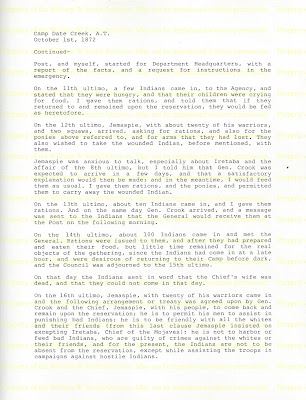
20129, 20130, 20131, 20132, 20133. Office of the U.S. Ind. Agent, Camp Date Creek, A.T., October 1st, 1872, Superintendent of Indian Affairs, Arizona Territory, Prescott, A.T. (letter)
Office of the U.S. md. Agent
Camp Date Creek, A.T.
October 1st, 1872
Superintendent of Indian Affairs,
Arizona Territory
Prescott, A.T.
Sir:
I have the honor to submit the following Report of the condition
of affairs at this Agency during the month of September 1872.
In my report of the month preceding, I made known to you, that
the Indians had during several weeks, suffered greatly from
disease, and that they appeared much disheartened thereby, and
that discontent and restlessness were manifested among them to a
considerable extent.
On the 1st day of the month, just closed, O-hat-che-com-a, Chief
of the Apache Mojave tribe, applied to me for permission to leave
the reservation, with a part of his band, for the period of
thirty days: assigning as a reason for his request, that disease
was making frightful havoc with his people, and that it was
necessary that they should go to the mountains for recuperation.
The conduct of this Chief, during his sojourn upon this
reservation, had been, as I was informed highly exemplary; and
upon consideration of the peculiar nature of the case, and
believing that a change of scene and diet would operate bene—
ficially upon the suffering sick of his people, I deemed it
judicious to grant, with certain restrictions, his request.
These restrictions were as follows:
1st.- That he was not to go further than one days journey from
the reserve. 2nd.- That he was to go to a certain designated
camping ground. 3rd.- That he was to report in person at the
Agency, once in each seven days. 4th.- That he was to return with
his band, if sent for, at any time, even before the lapse of the
period named. And lastly. that he was to leave his brother as an
hostage for the fulfillment of these conditions.
After the Chief had left the reservation, it was discovered that
the whole of his band (with the exception of his brother, and an
Indian, who is known by the soubriquet of “Indian Jim”) had
departed, and it was rumored that they did not intend to return.
On the 5th day of the month, Jose Bacote and Charlie (the two
Indians who had gone from this reservation to Washington with
Gen. Howard) returned, and stated that the Superintendent of
Indian Affairs would speedily arrive here, and that he wished to
have a long talk with all the Indians. This, was made known to
the Indians and on the following morning (the 6th ultimo), I
informed Te—ye-ma-jor (brother of the absent Chief) and Indian
Camp Date Creek, A.T.
October 1st, 1872
Continued-
Jim, that I desired them to go out, as guides, with one of my
employees, to the camp of O-hat-che-com-a, to verify that that
Chief had complied with my conditions; to find out the number of
people in his camp, and generally, to learn how they were faring.
This, Te-ye-ma-jor and Indian Jim promised to do, but when my
messenger, had prepared himself for the ride, the Indians were
nowhere to be found, and he was obliged to make the journey
alone. He reports, that he found the camp, but that it had been
entirely deserted by the Indians, a few days before. He followed
their trail (which led in the direction of the Black Mesa) for
about five miles, and then not having seen anything of them, he
returned to the Agency.
On that evening Capt. Byrne, accompanied by Iretaba, Chief of the
Mojave tribe and two other Indians, arrived here, and on the
following morning, the Indians on this reservation seemed much
exorcised concerning the presence of Iretaba.
It appears that there has heretofore, been much animosity
existing between the bands of this reservation, and the band of
Iretaba. In fact, the feud between them had grown to such
proportions that at one time (some months ago), as I was inf
ormed, the last mentioned band had sent a message to the Indians
here of the following import; that if any of them came over to
the Colorado Reservation, they would be killed, and I am also
informed that our Indians returned a like hostile message to the
band of Iretaba.
It was then by no means singular that these Indians indulged in
grave speculations as to why Iretaba had been called here, and
that much excitement was manifested among them. This excitement
was, in some measure, allayed, when, after I had brought together
the Mojave Chief and some of our head men and required them to
shake hands, Iretaba explained that he had come here merely
because Gen. Crook was coming, and desired to meet, and have a
talk with all good Indians.
On the same morning, Te-ye—ma-jor and Indian Jim came in, and
seemed particularly anxious to get possession of 0-hat—che-
corn-a’s revolver, which had been left with the Blacksmith of the
Post, for repairs. This, together with a wariness and restl
essness in their manner, convinced me that they premeditated
escape from the reserve, and for this reason, as well as for the
deception they had practiced the day before, I caused their
arrest, and confinement in the Guard House.
A few hours afterward Gen. Crook visited us, and informed me that
he wished to see all of the Indians as soon as Dr. Bendell
arrived.
Camp Date Creek, A.T.
October 1st, 1872
Continued-
Upon the arrival of Dr. Bendell on the afternoon of the 8th
instant, Gen. Crook informed the Superintendent and myself, that
there was evidence that several of the Indians upon this reserve,
had been concerned in the murder of the passengers on the
Wickenburg stage, last year, and in the perpetration of other
atrocities, and that it was his intention to arrest such Indians.
About the same time O—hat—che—com—a, unaccompanied by any number
of his band, made his appearance.
I do not deem it necessary to report herein, in detail, the
events that followed while the Superintendent was present.
Suffice it to say, that the condition of affairs, after the
attempt to arrest, and at the time of the departure of Dr.
Bendell was, as follows: Four Indians, count, 0-hat—che-com-
a, Te—ye—ma-jor, Ar—ra—poot—yer, and Indian Jim, were incarc
erated in the Guard House, and no other Indian (with the
exception of an aged and infirm man) were to be seen upon the
reservation.
In the morning of that day, the number who had received rations
were 398. These were all Apache Yumas. The band of 0-hat-che-
corn-a, being all sbsent.
During the night of the 8th ult., three of the Indians confined
in the Guard House, attempted to escape through the canvass roof,
and the soldiers firing upon them, Te-ye-ma-jor was killed.
O—hat—che—com—a and Indian Jim, although both were severely
wounded, succeeded in escaping in the darkness.
On the following morning (the 9th ult.) I visited the rancherias
of the Indians, and found them wholly deserted. I found four
ponies, a considerable number of cooking utensils, a quantity of
flour, and other articles, scattered here and there, abandoned by
the Indians in their hasty flight. I took charge of the ponies,
and have disposed of them as herein after indicated. An infant
child (male) which in my absence, had been brought in to the
Agency from one of the abandoned rancherias, was also taken
charge of by me, and is still properly cared for. An aged Indian,
badly wounded in the hip, was also found near the Camp, by the
soldiers, and brought in for surgical treatment.
On the 10th ultimo, some Indians came in, to Mr. Gilson, a
citizen who resides upon the reservation about three miles from
this Camp and who had displayed a white flag upon his ranche, and
had a talk with him, seeking an explanation, why the Indians had
been arrested on Sunday, and why they had been fired upon, and
expressing a desire to return to the reservation.
Mr. Gilson, after consultation with the Commanding Officer of the
Camp Date Creek, A.T.
October 1st, 1872
Continued-
Post, and myself, started for Department Headquarters, with a
report of the facts, and a request for instructions in the
emergency.
On the 11th ultimo, a few Indians came in, to the Agency, and
stated that they were hungry, and that their children were crying
for food. I save them rations, and told them that if they
returned to and remained upon the reservation, they would be fed
as heretofore.
On the 12th ultimo, Jemaspie, with about twenty of his warriors,
and two squaws, arrived, asking for rations, and also for the
ponies above referred to, and for arms that they had lost. They
also wished to take the wounded Indian, before mentioned, with
them.
Jemaspie was anxious to talk, especially about Iretaba and the
affair of the 8th ultimo, but I told him that Gen. Crook was
expected to arrive in a few days, and that a satisfactory
explanation would then be made; and in the meantime, I would feed
them as usual. I gave them rations, and the ponies, and permitted
them to carry away the wounded Indian.
On the 13th ultimo, about ten Indians came in, and I gave them
rations. And on the same day Gen. Crook arrived, and a message
was sent to the Indians that the General would receive them at
the Post on the following morning.
On the 14th ultimo, about 100 Indians came in and met the
General. Rations were issued to them, and after they had prepared
and eaten their food, but little time remained for the real
objects of the gathering, since the Indians had come in at a late
hour, and were desirous of returning to their Camp before dark,
and the Council was adjourned to the 15th ultimo.
On that day the Indians sent in word that the Chief’s wife was
dead, and that they could not come in that day.
On the 16th ultimo, Jemaspie, with twenty of his warriors came in
and the following arrangement or treaty was agreed upon by Gen.
Crook and the Chief, Jemaspie, with his people, to come back and
remain upon the reservation; he is to permit his men to assist in
punishing bad Indians; he is to be friendly with all the whites
and their friends (from this last clause Jemaspie insisted on
excepting Iretaba, Chief of the Mojaves): he is not to harbor or
feed bad Indians, who are guilty of crimes against the whites or
their friends, and for the present, the Indians are not to be
absent from the reservation, except while assisting the troops in
campaigns against hostile Indians.
Camp Date Creek, A.T
October 1st, 1872
Continued-
On the 17th ultimo, 79 Indians (of whom, there were 60 warriors,
10 squaws, 8 boys and 1 girl) came in. They stated that quite a
number of their Indians were sick, and that as soon as their
people got well, they would move in upon the reserve. I told them
that they had promised Gen. Crook, that they would come in at
once, and they must do so, for if the soldiers found them in the
mountains, they would kill them. I issued rations to them in
bulk, but told them that they would not receive full rations
until they came in with their families.
An Indian was found near the Post this day, wounded in the right
knee. He had had nothing to eat, except what he could pick up in
the bush, since the 8th ultimo. The Indians carried him back with
them on their return to their Camp.
On September 18th, four Indians came in, to the Agency, and
stated that one of Jemaspie’s children was sick, but that all the
Indians would be in, on the next day.
On the. 19th ultimo, Jemaspie, and twenty Indians came in for
rations. The Chief was quite ill, and stated that ten of his
Indians had died, and that the greater part of the remainder were
sick. He also stated that he could not come in upon the reserve,
for the present.
On the 21st ultimo, two Indians came in and stated that the
Indians would be in tomorrow (Saturday).
On the 22nd ultimo, rio Indians having appeared, I sent out two
Mexicans to seek their Camp. They returned with the report that
nearly all of the Indians had left that morning, for the
mountains, and evidently did not intend to return unless forced
to do so.
Up to the present date, nothing further has been developed.
There are no Indians on the reservation, except the one confined
in the Guard House, and the infant child above referred to, and
at the present date, there appears little prospect of their
speedy return.
I am Sir,
Very respectfully,
Your obedient servant,
J. Williams,
U.S. Special Indian Agent.
20125, 20126. Office Supt. Ind. Affairs Arizona Terty., Prescott, Sept. 30th, 1872. Hon. F.A. Walker, Commissioner Indian Affairs, Washington- D.C. (letter)
Office Supt. md. Affairs Arizona Terty.
Prescott Sept. 30th, 1872
Hon. F.A. Walker
Commissioner Indian Affairs
Washington- D.C.
Sir:
I have the honor to submit the following Report of General
Information for the month of September, 1872.
I returned to my office on the 9th inst., being delayed at San
Francisco to perfect arrangements for supplying and feeding the
Indians in accordance with Telegram from your office dated Aug.
5th, 1872.
On my arrival at Arizona City, I was met by Dr. Wilbur, Agent for
the Papagos who kindly assisted me in making the necessary
arrangements to transport the Indians, who had returned with me
from Washington, to their respective homes.
It was my intention on my way from the Colorado River to
Prescott, to stop at Camp Date Creek, interview the Apache
Mojaves & Apache Yumas on reserve at that point, & through their
representatives who had accompanied me to Washington; again to
convey to them the good intentions of the Government, and present
to their Chiefs (Ocho-ca-ma & Tho-mas-pai) the medals given me
(through Gen. Howard) by the President for the above named
Chiefs. On my arrival at Date Creek I was met by Gen’l. Crook,
who informed me that he had come to Date Creek, to arrest
Ocho—ca-ma, Chief of the Apache Mojaves for the murder of Col.
Leihy late Suptd’t. md. Affrs. for this Territory and also to
arrest three Indians who participated in the killing of Loring &
party in the Wickenburg Stage Massacre; he (Gen’l. Crook)
informing me that he had positive information, that the Indians
he intended to arrest were guilty of the crime of which they were
charged. I also learned from Agent Williams that the Indians
(especially the Apache Mojaves) under the leadership of Ochoc
a—ma, had behaved very bad during my absence from the Territory,
had refused to obey the Agent, left the Reserve without
permission and were insolent and defiant. I sent for the Chiefs,
told them that I wanted to talk with them and would meet them
that evening. On assembling in Council I found that but few
Indians were on the Reservation; not more than fifty were present
at the Council & the Chiefs refused to give me my information
concerning the absentees. At the termination of my interview
Gen’l. Crook attempted to arrest the guilty Indians, who resisted
and in the fight one soldier was stabbed one Indian was killed
and as I am informed several were afterwards reported wounded.
The Indians stampeded from the Post & fled to the Mountains.
Ocho-ca-ma was arrested & taken to the Guard-house but subs
equently escaped.
It is evident that the depredations committed in the valleys
between Date Creek & the Colorado River previous to this affair,
Office Supt. md. Affairs Arizona Terty.
Prescott Sept. 30th, 1872
Continued-
were committed by these Indians, and their absence from the
Reservation was for no good purpose.
During the month the Military have been active in scouting after
these Indians; on the 27th ultimo (40) forty of them were killed
& (10) ten taken prisoners. On the 30th ultimo (17) seventeen
were killed at Squaw Peak (50) fifty miles from Prescott, on
whose persons were found ration returns dated as issued up to the
29th ult.
The Apaches at Camp Grant and Camp Apache, still remain on the
Reserves; and I believe with judicious management will stay &
conform to the rules established by the Government for their
benefit.
At Camp Verde the Indians have been coming & going. It is evident
that they are anxious to receive rations, but not willing to
remain within the Reservation limits. Mr. Jacobs having been
relieved from the Agency at Camp Grant, is now en route to Camp
Verde, and I hope in my next report to give more favorable
accounts of the condition of affairs at that Reserve.
The condition of the Pimas & Maricopas, Papagos, Mojaves, and
Hualpais remains unchanged, the former are now enjoying the
benefit of a fair average crop, and the Hualpais are assisting
Gen. Crook as Scouts against the hostile Apache, and I anticipate
no trouble from them.
Ample arrangements for feeding the Indians at the various
Reservations have been made and sufficient supplies are en route
to guard against any contingency.
I respectfully call the attention of the Hon. Commissioner to my
letter of the 21st ult. regarding the purchase of Clothing and
Blankets for the Indians; the weather in some parts of the
Territory is very severe and unless these articles are purchased
& issued, great suffering will necessarily follow.
The Annuity Goods for the Pimas, Maricopas, Papagos, and Mojaves
have all been sent, and are being issued to said Indians.
I am Sir,
Very respectfully,
Your obd’t. servt.,
H. Bendell,
Superintendent.
January 5, 2019
20119, 20020. Pacific Mil. Div., Asst. Adjt. Gen., Headquarters Department of Arizona, Prescott, September 18th, 1872 (letter)
Pacific Mu. Div.
Asst. Adjt. Gen.
Headquarters Department of Arizona
Prescott, September 18th, 1872
Sir:
I have the honor to report that for some time I have been
satisfied who the parties were who committed the massacre of the
stage passengers via Wickenburg last November, in which Mr.
Loring and others lost their lives, and have been keeping as
quiet about it as possible while using every endeavor to get the
individual Indians into position so as to capture them.
Having completed my arrangements, I left here on the 6th instant
to meet Irataba, the Chief of the Mojaves with an Interpreter at
Date Creek. The Chief was cognizant of the massacre and the
parties who committed it, and was to identify such as were
present at the council at Date Creek, so that the arrest could
be made.
On arriving at Date Creek I found that at least two thirds of
the Indians, belonging on the reservation were absent from it,
and that one band had left in a defiant manner, stating that
they were not coming back, while others had left with the
permission of the Agent to go to a certain place with the
promise to come in whenever he sent for them, both of which
promises they had failed to keep, and in addition several bands
of stock were stolen from parties on the road from Date Creek to
Ehrenberg, the trails leading to the country over which these
Indians were roaming.
The Indians who were at Date Creek seemed uneasy and suspicious,
and in very bad temper, approaching with their arms and war
paint. Some of the parties who had participated in the stage
massacre were there, but very uneasy, and when the Indians were
assembled I had some men detailed to make the arrests as soon as
the Indians were identified. As they were designated the
soldiers stepped up to arrest them, when one of the Indians
friends, standing back of the soldiers, stabbed one of them in
the back. A shot was fired, by whom I could hardly say, but I
think it was by the soldier stabbed, and in an instant firing
commenced on both sides, the Indians making for the hills. I
made every effort, as did all the officers present to stop the
firing, but it was all over in an instant.
I returned to Prescott on the 9th, and on the 10th instant,
received a despatch from the Commanding Officer of Camp Date
Creek stating that the Indians wanted to talk with me and I went
there at once.
The Indians came in again and I promised them that I would grant
amnesty to all the assassins, except one of the ring leaders who
Headquarters Department of Arizona
Prescott, September 18th, 1872
Continued-
was still at large, as I had one in the guard house and two
others were killed. Upon this, nearly all the Indians I had met
the first time came in again and said if I would allow them to
remain— they would be responsible for all the Indians who would
come in. They did not deny their complicity with the stage
massacre, but said there were a good many bad Indians among
them, and that therefore they had been afraid to tell on each
other, when depredations were committed. They promised that
hereafter they would not only tell me when any depredations were
committed, but they would go out with the troops if necessary,
to punish the offenders.
0
As much as I regret that the arrest could not have been made
without trouble, I am well satisfied that as it now transpires,
the affair will be productive of good, as it is upon this basis
and no other that you can rely upon Indians who come in upon our
reservations.
The applications must come from them, and not from us, they must
sue to come in, and not feel all the time, that they confer a
favor upon us by doing so.
I am Sir very respectfully,
Your obedient servant,
George Crook,
Lieut. Colonel 23rd Infantry,
Brevet Major General,
Commanding Department.
20114. Office U.S. Indian Agency, Camp Date Creek, A.T., September 7th, 1872, Lieut. W.J. Volkmar U.S.A., Commanding Officer (letter)
Office U.S. Indian Agency
Camp Date Creek, A.T.
September 7th, 1872
Lieut. W.J. Volkmar U.S.A.
Commanding Officer
Camp Date Creek, A.T.
Sir:
I have the honor to request that Te-ye-madeya (brother to 0-
hot—che-ca-ma, Chief of Apache-Mohave Indians) and Indian Jim be
confined in Guard House until the said Chief and his band return
to this reserve.
Very respectfully,
Your obedient servant,
3. Williams,
U.S. Indian Agent.
20112. The Arizona Miner, Prescott, Arizona Territory, September 7th, 1872. From Yuma County. Dr. H. Bendell, Superintendent of Indian Affairs (letter)
The Arizona Miner
Prescott, Arizona Territory
September 7th, 1872
FROM YUMA COUNTY.
Dr. H. Bendell, Superintendent of Indian
Affairs for this Territory, had arrived.
He is coming to Prescott via Ehrenberg.
John Wasson, of the Tucson Citizen, had
passed through on his way to San Diego.
Dr, R.A. Wilbur, Rev. Mr. Cook, and the
Pima and Papago Indians, who recently
visited Washington, had gone up the Gila
road. The two Date Creek savages were
awaiting a steamer to convey them to
Ehrenberg.
20111. Wickenburg, A.T, September 6th, 1872, Commanding Officer, Camp Date Creek, Dear Sir, All of my stock at Culling's station... (letter)
Wickenburg, A.T.
September 6th, 1872
Commanding Officer
Camp Date Creek
Dear Sir:
All of my stock at Culling’s station was stolen last night, 18
head, by Indians. You will see by the letter I enclose from him
that he thinks they were Date Creek Indians. If you could assist
in pursuing them, you would confer a great favor, as all of the
stock was taken with the balance.
James Grant
20110. Culling's Well, September 5th, 1872, Mr. Pearson, The Indians have taken all the stock out of the corral last night... (letter)
Culling’s Wells
September 5th, 1872
Mr. Pearson:
The Indians have taken all the stock out of the corral last
night, they left me on foot.
If you can get some soldiers from Date Creek, we will follow
them and see what Indians they are. I think they are Date Creek,
as they went through Pen-hatchi-pet Pass towards New Water.
Yours,
Chas. Culling
January 3, 2019
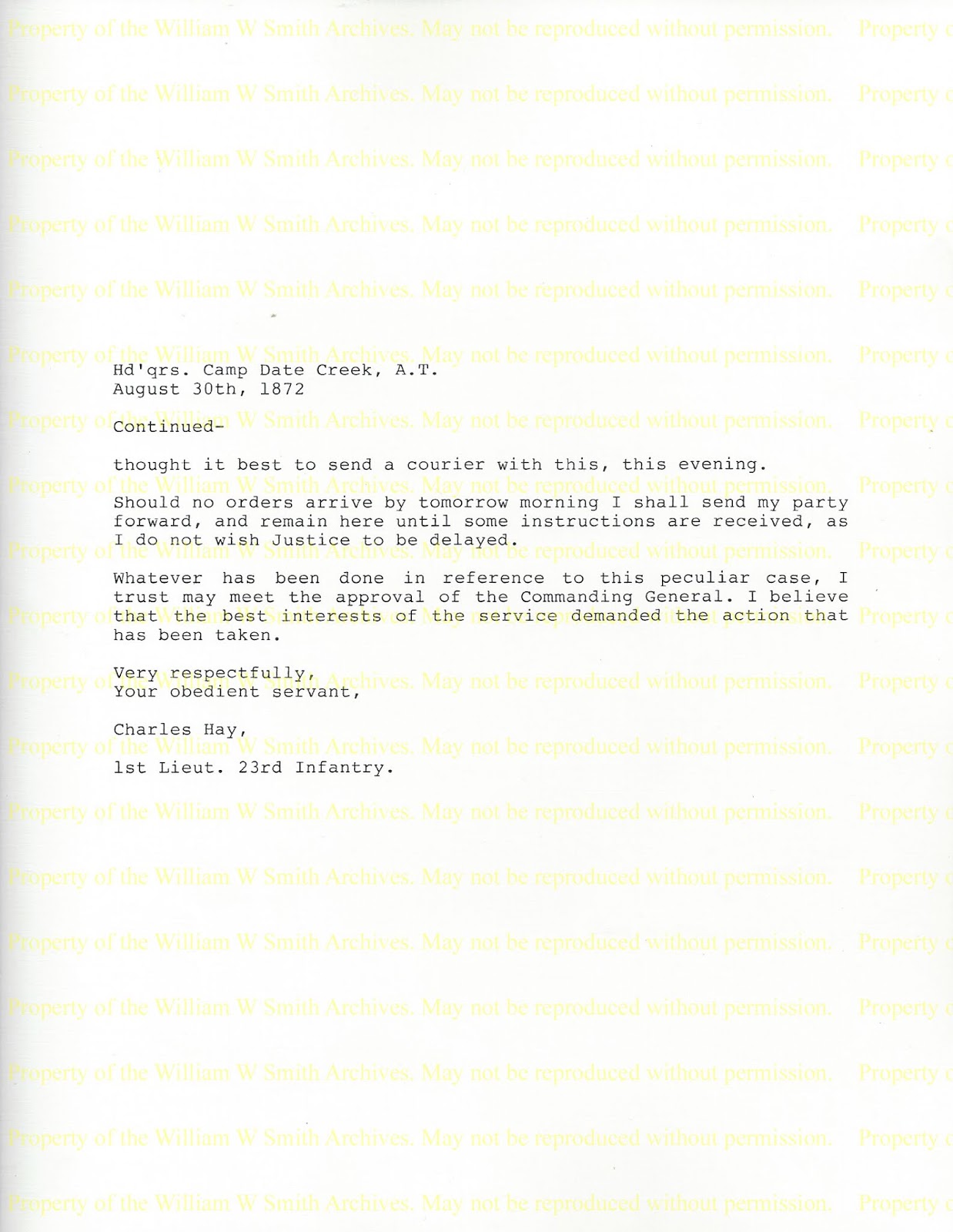
20105, 20106. Hd'qrs. Camp Date Creek, A.T., August 30th, 1872, Captain A.H. Nickerson 23rd Inf., A.A.A. General, Dept. of Arizona, Prescott, A.T. (letter)
Hd’qrs. Camp Date Creek, A.T.
August 30th, 1872
Captain A.H. Nickerson 23rd Inf.
A.A.A. General
Dept. of Arizona
Prescott, A.T.
Captain:
I have the honor to state that I arrived at this Post last
night about 9 o’clock, having hasten forward, (and leaving my
party to come on today) immediately upon learning of the death
of Captain Dwyer, of which you have been advised. Though Lt.
Bourke was at the Post in advance of me I deemed it proper that
I should also be here as soon as possible. As I was aware of
the important nature of Lt. Bourkes’ orders, and knew also that
no officer was here except him, and he might wish to pursue his
journey without delay, and as a great amount of public property
would thus be left without an officer present, I considered it
to be my duty to waive all other considerations and give my
attention to this matter; although Lt. Bourke stated he would
have remained had no one arrived.
The circumstance were of such a peculiar nature (and perhaps
the case has no precedent) that Lt. Bourke, in the name of the
Dept. Commander, at once, authorized me to take command, (copy
of letter enclosed) which I did; at the same time obtaining
possession of the store house and safe keys, and I have since
put everything in as secure a condition as practicable.
The funeral of Captain Dwyer took place at 11 AM today, it
being an absolute necessity, as the body was rapidly
decomposing and becoming extremely offensive, so much so, that
the Post Surgeon gave as his professional opinion that it was
unadvisable, if not dangerous to assume the risks of generating
contagion by deferring the interment. This I trust will
satisfactorily explain what might otherwise have the appearance
of undue haste. The Post Surgeon also states that a postm
ortem examination was not necessary to discover anything
relative to the death of Captain Dwyer of which he (the
surgeon) was not already aware.
Lt. Bourke left here immediately after the funeral. Before
leaving he stated that when he should meet the troops, now on
route from Ehrenberg, he would immediately send an officer if
one could be spared to take command of this Post.
Nothing as yet (4 PM) having been received in answer to
dispatches forwarded yesterday morning to Dept. Hd’qrs., I have
Hd’qrs. Camp Date Creek, A.T.
August 30th, 1872
Continuedt
hought. it best to send a courier with this, this evening.
Should no orders arrive by tomorrow morning I shall send my party
forward, and remain here until some instructions are received, as
I do not wish Justice to be delayed.
Whatever has been done in reference to this peculiar case, I
trust may meet the approval of the Commanding General. I believe
that the best interests of the service demanded the action that
has been taken.
Very respectfully,
Your obedient servant,
Charles Hay,
1st Lieut. 23rd Infantry.
20104. Date Creek, A.T., August 29th, 1872, General Adjutant, Dept. of Arizona, Captain: I have the honor to report that upon arriving... (letter)
Date Creek, A.T.
August 29th, 1872
General Adjutant
Dept. of Arizona
Captain:
I have the honor to report that upon arriving at this place, I
found that Captain Dwyer, 5th Cavalry- Commanding Post, had
suddenly died during the night of August 28th, and there being
no other officer present, and no one to take charge, I assumed
the responsibility of taking Command until the arrival of Lieut.
Hay, 23rd Inf. Beyond seeing that desks, etc. were properly
secured, I had no time to do anything except make preparations
for the burial of the remains, rapidly decomposing from the
effects of the sultry weather. Lieut. Hay arrived about six (6)
hours after I did, and is now in Command having in his
possession the keys, etc. of the deceased.
I have the honor to be Sir,
Very respectfully,
Your obedient servant,
3ohn G. Bourke,
2nd Lieut. 3rd Cavalry.
A true copy,
Charles Hay,
1st Lieut. 23rd Infantry.
January 1, 2019
20096, 20097. Personal correspondence between Bill W. Smith and Barry Goldwater (February 11, 1992 and March 10, 1992) (letter)
Barry Goldwater
P. 0. BOX 1601
SCOTTSDALE, ARIZONA 55252
February 11, 1992
Mr. Bill W. Smith
Phoenix, AZ
Dear Bill:
When I returned home from your store this morning, I found
your letter waiting. I’m very happy that your writing the
story on the army post. It will be a terrific addition to
the literature of Arizona. That part of Arizona has largly
been neglected by historians, and I’m very happy for what
your doing.
I do know that my Grand Uncle Joe was hit by two bullets by
raiding Apaches, although I didn’t know that Dr. Jones was
traveling with them. He wore those two bullets as watch
fobs for the rest of his life. My Grandfather Mike, was
shot through the hat, with no damage.
I do not have much in the way of specific information for
you, but you’ve been working with Susie Sato, and in my book
you can’t beat her.
Keep i touch on this, and if I hear anything I’ll let you
know.
Barrij Goldwater
March 10, 1992
Mr. Bill W. Smith
Phoenix, AZ
Dear Bill:
P. 0. BOX 1601
SCOTTSDALE, ARIZONA 85252
Thank you for the copy of the Goldwater article by Dean
Smith. I certainly do appreciate it, and thanks too for
that article by James Cook.
I think your on a real project. Camp Date Creek was just a
hidden little waterway until you came along. When you
chronicle the whole story, it will become one of the
important places in Arizona’s wonderful history.
The fact that both my grandfather, and grand-uncle, were
both shot on that trip, that wound up in Date Creek, is very
importanj, to both me and my family. Thank you for doing
this, iA/s really a wonderful job for Arizona.
S.
December 31, 2018
20085. The Army and Navy Journal, Volume IX, Number 29, Saturday, March 2nd, 1872. Colonel R.F. O'Beirne, U.S. Army, Commanding (letter)
The Army And Navy Journal
Volume IX, Number 29
Saturday, March 2nd, 1872
Colonel R.F. O’Beirne
U.S. Army, Commanding
Sir:
In reply to your request for a statement from me in regard to the
medical and general treatment of William Kruger and Mollie
Sheppard, while at this post, I have the honor to state that on
the receipt of the information of the stage being attacked
between Wickenburg and Ehrenberg, you ordered me to proceed
without a moment’s delay, and render such assistance as the cases
required. On my arrival at Wickenburg I found the only survivors—
Mr. Kruger and Miss Sheppard, wounded; Kruger slightly, and the
woman badly in the upper third right arm. Having been informed
that no proper medical aid could be procured at the latter place,
and in consultation with Captain Meinhold in regard to the
matter, we came to the conclusion to remove them to a point near
Camp Date Creek where they would receive proper care and
attention. On our arrival at the post, it being near dark the
woman was placed in the quarters occupied by the hospital matron,
until such time as arrangements could be made for her removal to
Mr. Gilson’s, on the reservation, (2½) miles from camp.
On visiting her the morning after her arrival, I found her arm
much swollen and inflamed, and so reported to you, when I was
ordered to keep her there until such time as she could be removed
without harm to herself to more comfortable quarters.
Also, that I should admit William Kruger to hospital for
treatment, etc., he refusing to go into hospital and preferring
to remain at the matron’s with the wounded woman until such time
as she had recovered sufficiently to be removed to Mr. Gilson’s
where he accompanied her and where they remained until entirely
recovered. I take pleasure in stating that every assistance was
rendered me by the commanding officer of this post, and that
every comfort that they could well have received was extended to
them.
I am sir,
Very respectfully,
Your obedient servant,
D.J. Evans,
Post Surgeon,
CAMP DATE CREEK, A.T., January 27th, 1872.
20082, 20083, 20084. The Army And Navy Journal, Volume IX, Number 29, Saturday, March 2nd, 1872. (letter)
The Army And Navy Journal
Volume IX, Number 29
Saturday, March 2nd, 1872
To the Editor of the Army and Navy Journal.
Sir:
I take advantage of your offer to publish any corrections of the
letter which appeared in your issue of the 6th inst., over the
signature of one “Wm. Kruger, chief clerk to Captain C.W. Foster,
assistant quartermaster U.S. Army,” deeming it but my duty to
contradict the statement which so unjustly reflects on an officer
of my regiment. Being personally cognizant of everything
connected with the attack on the Wickenburg stage, and the
subsequent treatment of Mr. Kruger and Miss Sheppard by Captain
R.F. O’Beirne, Twenty-first Infantry, commanding this post, I can
only state to you that there is not a particle, not a shadow of
foundation or truth in anything Mr. Kruger states in his letter,
excepting the mere circumstances of the stage attack and the
particulars of the untimely death of poor Mr. Loring. The facts
in the case are simply these: Word was received at this post
about 8 AM on Monday morning, November 6th, 1871, that the stage
which left Prescott on the 4th for California, had been attacked
about seven miles from Wickenburg, and that six persons had been
killed and two wounded. Colonel O’Beirne at once sent Captain
Charles Meinhold, Third Cavalry, with Lieutenant Simpson and some
twenty odd enlisted men to the scene of the disaster, with
instructions to follow the trail, and if possible discover the
perpetrators of the attack, it being at the time a matter of
grave doubt whether the attack was made by Indians or Mexicans.
He also sent the post surgeon, Dr. Evans, to Wickenburg to assist
in attending to the wounded. The latter returned on Tuesday the
7th, bringing with him the two wounded passengers Mr. William
Kruger, and his fideu Achates Miss Mollie Sheppard, a Prescott
prostitute and keeper of a house of ill-fame, with whom he was
travelling. Mr. Kruger, who was but slightly wounded, was invited
by Colonel O’Beirne to place himself under the doctor’s care at
the post hospital, while Miss Sheppard was taken by the Doctor to
the quarters of one of the laundresses. Everything was done for
these people that it was possible to do. Mr. Kruger occupied the
quarters of an officer who was temporarily absent from the post,
and received every attention, while to Miss Sheppard word was
sent by my wife, through the Doctor, that anything she might need
in the way of wearing apparel was at her service. Mr. Kruger,
however, seemed to be much offended that his companion was not
shown more attention or taken into the quarters of one of the
officers; and as far as I am personally concerned, I confess I
would much rather have shown this attention to her than him, she
being a poor unfortunate woman, while Mr. K. is an intelligent
man, who had already so far degraded himself that Captain C.W.
Foster, whose chief clerk he was, discharged him, and that his
own brother- so at least I am informed by reliable partiesw
ould not recognize or speak to him while at Ehrenberg.
To the Editor of the Army and Navy Journal- Continued.
There being no proper place in the post for Miss Sheppard,
Colonel O’Beirne told the Doctor that as soon as she was well
enough to be moved he would prefer if he (the Doctor) would have
her removed to Mr. Gilson’s ranch, a comfortable house about two
miles from the post, but on the reservation, where she would be
in every way better off, and where the post surgeon could go
every day to attend her. About a week after the arrival of the
“two surviving cripples,” the Doctor reported the woman well
enough to be moved, and they (Mr. Kruger of his own accord
accompanied her) accordingly went to Mr. Gilson’s, where Dr.
Evans attended them daily for several weeks and until they were
well enough to leave.
There is another point in Mr. Kruger’s statement that I desire to
contradict. I quote from the letter published in the Journal of
the 6th.
“That I left my mark with the Indians, there is no doubt, because
two Indians died from gun-shot wounds at Camp Date Creek
Reservation; but the commanding officer refused to have the thing
investigated, for fear he would find sufficient evidence that
they were his pets- that is, Camp Date Creek Indians. At all
events there is no doubt whatever that the outrage was committed
by Indians, and that by Camp Date Creek Indians, those so-called
friendly Indians whom Uncle Sam feeds These citizens
tracked the Indians from the place of outrage to Camp Date
Creek.”
Being myself issuing commissary for the Indians here— ApacheY
umas and Apache-Mojaves, each of whom comes daily to the post to
draw his rations from me, and knowing from my intercourse with
them each individual Indian, I can positively assure you that no
Indian or Indians have ever died from gun-shot wounds on this
reservation, and as on his arrival here, I particularly noticed
Mr. Kruger’s pistol, from which not one single shot had been
discharged, and which did not present the appearance of having
been recently reloaded, I am very much inclined to think that he
did not “leave his mark with the Indians.”
I am furthermore prepared to testify to the fact that every
effort was made by Colonel O’Beirne to discover if these so-
called Camp Date Creek Indians were the guilty parties. The iron
loop of a mail-sack was found with one of them, and at once sent
to the postmaster at Wickenburg, A.T., for identification, who
returned it saying that the mailsacks on the ill-fated stage were
only cut open, but no part of them was missing; some legalt
ender notes were found upon another and taken from him, but were
afterward identified by Mr. Charles B. Genung, of Peeples’
Valley, as money he had paid this Indian for work done upon his
ranch; every effort, in fact, was made, but nothing was elicited
to fix the crime upon the Indians here. Not only this, but
Colonel O’Beirne also went in person to Wickenburg and collected
To the Editor of the Army and Navy Journal- Continued.
the effects of the deceased, which he forwarded to Lieutenant
Wheeler, Corps of Engineers, from which he received a very
handsome letter in reply.
In regard to the statement that the trail led from the place of
attack to this post, I have only to say that Captain Meinhold,
Third Cavalry, went to the place of attack and took up the trail,
which took the direction of this post for about one mile and then
turned southeast and continued in almost the opposite direction
from this place.
I have already taken up more of your space than I first intended,
for the unblemished and Christian character of Captain and Brevet
Lieutenant-Colonel R.F. O’Beirne is to well known throughout the
Army, to be stained with the mire thus thrown at him by Mr.
Kruger, but as his (Kruger’s) letter has been extensively
published and commented upon by the press, I merely wish, in
justice to a brother officer, to correct this foul slander.
Fred H.E. Ebstein,
Second Lieutenant Twenty-first Infantry.
CAMP DATE CREEK, A.T., January 26th, 1872.
20080, 20081. The Army and Navy Journal, Volume IX, Number 29, Saturday, March 2nd, 1872. To the Editor of the Army and Navy Journal (letter)
The Army And Navy Journal
Volume IX, Number 29
Saturday, March 2nd, 1872
To the Editor of the Army and Navy Journal.
Sir:
My attention has been called to a letter addressed to William C.
Peckham, Esq., Trinity Building, New York and signed by William
Kruger, chief clerk to Captain C.W. Foster, assistant quarterm
aster U.S. Army, pretending to give an account of the massacre
near Wickenburg, in which Mr. Fred Loring and others were killed.
Were I to consult my own inclinations and disregard the wishes of
my friends, I would pass this letter by with the contempt it
deserves. It is charitable to suppose that Mr. Kruger must be
insane, for it is only on this theory that one can account for
the falsehoods which his letter contains.
Without going into details I positively assert that every
statement Mr. Kruger has made in that letter as regards my
treatment of him and “Miss Sheppard” and my conduct in the
investigation of the sad affair, is false in every particular,
and that no one is better aware of this than Mr. Kruger.
The report of the attack on the stage reached me some twenty-
two hours after its occurrence. I immediately ordered Captain
Meinhold and Lieutenant Simpson, with a detachment of Troop B,
Third Cavalry, to proceed to the point of attack, to pursue the
assassins, and if not successful in overtaking them, to find out
if possible from whence they came. I also sent the post surgeon
to attend to the wounded.
Captain Meinhold in his report states that the tracks, which he
followed some twenty-five miles from where the stage was
attacked, after leading for some distance towards this post,
turned off in an opposite direction. There is not one particle of
evidence to show that the Indians on the Date Creek Reservation
had anything to do with the massacre. The statement that two
Indians died from gunshot wounds on this reservation shortly
after the sad occurrence is false; indeed I am informed by an
officer who examined Mr. Kruger’s revolver on his arrival at this
post that there was not one shot fired out of it.
With regard to the charge of inhumanity towards Mr. Kruger and
“Miss Sheppard,” I prefer to let others speak, and forward you
herewith, statements from Lieutenant Ebstein, Twenty-first
Infantry, and Dr. Evans, the surgeon of the post, which show
conclusively that every comfort and attention that could readily
be shown them was freely extended.
I am loath to add, but simple justice compels me to statew
ith the view of showing the character and standing of Mr.
Kruger, that “Miss Sheppard” who was travelling under his
To the Editor of the Army and Navy Journal- Continued.
protection and to whom he so feelingly alludes, is a notorious
prostitute (not—withstanding, I believe her to be much the better
character of the two) who has for a long time, I am informed,
enjoyed the questionable care and patronage of Mr. Kruger.
With great respect,
Your obedient servant,
R.F. O’Beirne,
Captain Twenty-first Infantry.
CAMP DATE CREEK, ARIZONA, January 27th, 1872.
December 29, 2018
20072, 20073, 20074. The Army And Navy Journal, Volume IX, Number 21, Saturday, January 6th, 1872. Twenty-first Infantry. (letter)
The Army And Navy Journal
Volume IX, Number 21
Saturday, January 6th, 1872
Twenty-first Infantry.
From Boston a correspondent of the New York Times sends the
following letter from one of the survivors of the Loring
massacre, giving an account of that massacre, and reflecting on
the conduct of one of the officers of this regiment with
reference to it. We publish the letter as it bears a responsible
signature, but shall be glad to publish any correction of its
statements:
Ehrenberg, A.T., December 9th, 1871.
William G. Peckham, Esq.
Trinity Building, New York
Dear Sir:
In acknowledging the receipt of your letter of November 16th,
1871, I am pleased to be able to give you an account of the death
of my friend Loring, who was well known to me and whose untimely
death is deeply regretted by me. We left Fort Whipple, near
Prescott, Arizona Territory, on Saturday, November 4th, in the
best of health and spirits. To be sure, the stage was rather
crowded, but being all of such good temper we had a real nice
time, Loring being the most lively of us all, anticipating a
speedy return to his friends East. Well he retained his inside
seat until we reached Wickenburg, on Sunday morning, November
5th, 1871, when, after leaving there, he preferred to have an
outside seat, to which I most decidedly objected; but he insisted
on being outside for a short time. I had two revolvers and he had
none; in fact, no arms whatever. He rejected my offer of a
revolver, saying at the same time, “My dear Kruger, we are now
comparatively safe. I have travelled with Lieutenant Wheeler for
nearly eight months, and have never seen an Indian.” Well we
rolled on until about 11 AM, when the fatal attack was made. The
first warning I had was the warning of the driver, who cried
“Apaches! Apaches!” At the same moment the Indians, who lay
concealed, fired the first volley, killing poor Loring, the
driver, and the other outside passenger, a Mr. Adams. They killed
also the off lead horse and wounded the other lead horse. The
horses very much frightened, then ran forward about twenty yards,
when they came to a sudden stop. At the same time Loring fell off
the stage and so the other passenger. At the same moment the
Indians fired the second volley from three sides- the both sides
and rear— not more than four or five yards from the stage,
killing Mr. Shohoim, one of the inside passengers, and wounding
Miss Sheppard, myself and a Mr. Salmon, of Lieutenant Wheeler’s
party. The latter one was mortally wounded and fell out of the
stage, and crawled away, but was finally captured by the Indians,
scalped and otherwise mutilated. The only one not then wounded
Letter from Army and Navy Journal— Continued.
was Mr. Hamel, of Lieutenant Wheeler’s party. Both he and myself
commenced immediately firing. Each one fired six shots. Not
having any more ammunition I ceased firing. The Indians then
disappeared behind the bushes.
But what a terrible spectacle it was to see the six dead bodies
in plain sight! Loring was lying right under my very eyes, not
yet dead, but suffering, apparently, terribly. He was shot
through his left temple, his right eye, and his lungs. He
suffered for about four minutes, but I am positive that he died
before I made my escape. Knowing that it would be useless to
attempt to escape until the Indians would come back to plunder
the stage, I remained perfectly quiet, having in the mean time
ascertained that Miss Sheppard was yet alive, but badly wounded.
She succeeded in getting a loaded revolver from one of the killed
passengers, which she gave to me. I then told her to keep cool
and be ready to run as soon as I would give the signal. Well, in
about six minutes of terrible suspense I saw the Indians slowly
creeping toward the stage. I counted and saw plainly fifteen
Indians all dressed in blue soldiers’ trousers. When they came
within five yards of the stage I jumped up, yelled and fired at
them. The woman, at the same time, yelled also, and we succeeded
admirably in driving them off for the time being, and got time to
leave the stage. Before I left the stage I cried out as loud as I
possibly could if any one was left alive, but only Mr. Adams
answered; but he was mortally wounded and could not even move his
hands or feet, so I had to leave him to his fate. He was
afterward found with his throat cut and otherwise mutilated. The
Indians afterward followed me for about five miles, and I had a
running fight with them until I fell in with the “buck-board.” I
had to carry the wounded woman for over two miles in my left arm.
I myself received one shot through the right armpit, coming out
on the shoulder, and two shots in my back. The woman also had
three shots, one dangerous.
How I could escape with my life, and be able to save the life of
Miss Sheppard, is more than I can account for. That I left my
mark with the Indians, there is no doubt, because two Indians
died from gun—shot wounds at Camp Date Creek Reservation; but the
commanding officer refused to have the thing investigated, for
fear he would find sufficient evidence that they were his pets-
that is Camp Date Creek Indians. At all events there is no doubt
whatever that the outrage was committed by Indians, and that by
Camp Date Creek Indians, those so-called friendly Indians whom
Uncle Sam feeds.
After the news reached Wickenburg, we were brought to Wickenburg
after sixteen hours of terrible suffering and agony. I stopped at
the place of attack and closed the eyes of all my poor travelling
companions. Loring, poor boy, was not mutilated, but looked calm
and peaceful, excepting his fearful wounds through the head. He
wore soldiers’ clothing. His hat is in my possession now; if you
wish it you can have it. Loring and four of his companions in
Letter from Army and Navy 3ournal- Continued.
fate were decently buried the next day, Monday, November 6th,
1871, in nice coffins. I saw them buried. The other man who got
scalped was buried on the road. Mr. Sexton, of the Vulture Mill,
at Wickenburg, attended to the funeral. Rest assured that our
friend Loring had a decent funeral. Peace be with his ashes. I
forwarded everything belonging to Loring to Lieutenant Wheeler,
excepting his hat, which you can have should you desire it. There
are four bullet—holes through the same. What Loring lost I don’t
profess to know. I know, I lost everything but my life. The
Indians got, to my certain knowledge, about twenty-five thousand
dollars- nine thousand dollars belonging to me and Miss Sheppard.
There is not a particle of doubt in my mind that the attacking
party were Indians. I have known Indians since the last five
years, and cannot be mistaken; besides, all indications show that
they were Indians. Every citizen here will swear to it, because
these citizens tracked the Indians from the place of outrage to
Camp Date Creek. But the commanding officer, Captain O’Beirne,
Twenty-first Infantry, not only allowed the Indians to go
unpunished, but also refused me, Miss Sheppard, the two surviving
cripples, shelter. Yes sir; he ordered us off his reservation,
and I wish to heaven you would publish this act of inhumanity in
your New York papers. Please show this letter to Mr. Loring,
Boston, Mass., who wrote to me the same time you did.
I am sir,
Very truly yours,
William Kruger
Chief Clerk to Captain C.W. Foster, Q.M., U.S.A.
Subscribe to:
Posts (Atom)